Intermittent fasting has been studied for weight loss, blood sugar control, and longevity. But its effects on mitochondria may be its most profound and underappreciated benefit.
The short answer to the title question: yes, dramatically — and through multiple distinct mechanisms.
How Fasting Affects Mitochondria
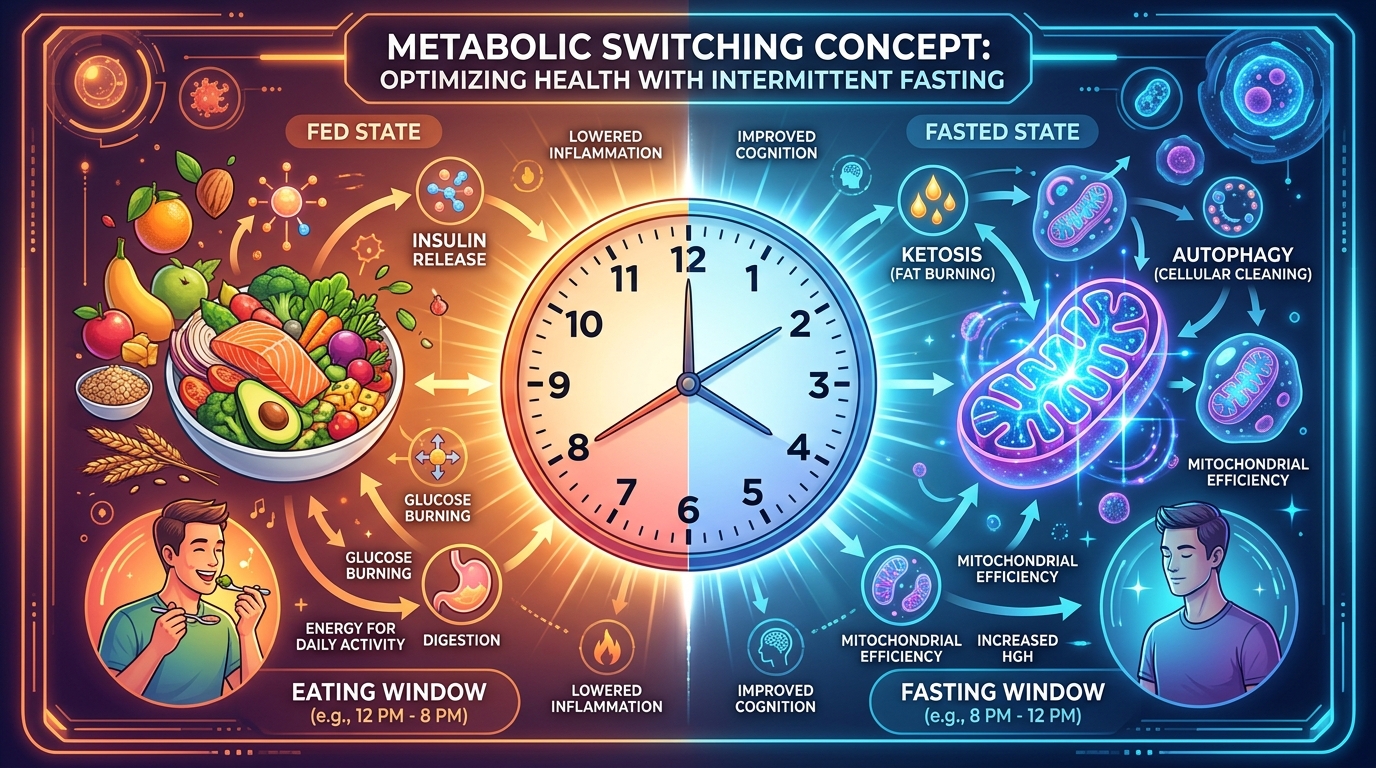
When you eat constantly (the typical 3 meals + snacks pattern), your cells primarily burn glucose for energy. Mitochondria operate in a relatively stable, low-stress state.
When you fast, a cascade of metabolic changes transforms mitochondrial function:
1. Metabolic Switching to Fat Oxidation
After 12–16 hours of fasting, glycogen stores deplete and the body switches to fat oxidation. Fatty acids are transported into mitochondria via carnitine and undergo beta-oxidation.
Fat oxidation is a “cleaner” fuel for mitochondria — it produces fewer reactive oxygen species per ATP than glucose oxidation. This reduced oxidative stress benefits mitochondrial membrane integrity.
2. Ketone Production
As fat oxidation intensifies, the liver produces ketones (primarily beta-hydroxybutyrate, or BHB). Ketones:
- Are an efficient fuel for mitochondria
- Act as signaling molecules that activate SIRT3 (a key mitochondrial sirtuin)
- Reduce mitochondrial oxidative stress
- May protect mitochondria from exercise-induced damage
3. AMPK Activation
Fasting lowers cellular energy status, activating AMPK (AMP-activated protein kinase) — the master energy sensor.
AMPK activation:
- Stimulates mitochondrial biogenesis through PGC-1α
- Promotes mitophagy (clearance of damaged mitochondria)
- Inhibits mTOR (which normally suppresses autophagy)
4. mTOR Inhibition → Autophagy
mTOR (mechanistic target of rapamycin) is the primary growth and anabolism regulator. When nutrients are available, mTOR is active and suppresses autophagy.
Fasting reduces mTOR activity, allowing:
- Autophagy to proceed (including mitophagy)
- Damaged mitochondria to be cleared
- Cellular quality control to reset
5. NAD+ Increase
Fasting increases cellular NAD+ levels through reduced consumption. Higher NAD+ activates:
- SIRT1 and SIRT3 (mitochondrial deacetylases that improve mitochondrial function)
- PARP-1 regulation (DNA repair)
This NAD+ increase during fasting synergizes with NMN/NR supplementation.
6. Mitochondrial Biogenesis
The combination of AMPK activation, PGC-1α upregulation, and ROS signaling during fasting stimulates mitochondrial biogenesis — the creation of new mitochondria.
Studies in both animals and humans show increased mitochondrial density and improved mitochondrial enzyme activity after sustained fasting or caloric restriction.
What the Research Shows
Animal Studies (Very Strong)
- Caloric restriction extends lifespan in every model organism tested
- Intermittent fasting improves mitochondrial function, reduces oxidative damage
- Fasting reverses age-related mitochondrial decline in mice
Human Studies (Strong and Growing)
Ramadan studies: Natural experiments in which Muslims fast 14–18 hours daily for a month. Consistently show improved metabolic markers, reduced inflammation, and improved mitochondrial function markers.
16:8 IF studies: Multiple RCTs show improved insulin sensitivity, reduced inflammatory markers (IL-6, TNF-α, CRP), and improved metabolic function.
VO2 max: Some studies show improvements in aerobic capacity with IF, suggesting improved mitochondrial oxidative capacity.
Cardiovascular: Reduced blood pressure, improved lipid profiles, reduced oxidized LDL — all consistent with improved mitochondrial health.
Fasting Protocols: Which Is Best for Mitochondria?
Different protocols have different mitochondrial effects:
| Protocol | Fasting Window | Mitochondrial Benefit | Practicality |
|---|---|---|---|
| 12:12 | 12h | Mild | Very easy |
| 16:8 | 16h | Moderate-strong | Manageable |
| 18:6 | 18h | Strong | Challenging |
| OMAD | 22-23h | Very strong | Very difficult |
| 5:2 | 2 days 500 kcal | Moderate | Moderate |
| 24h weekly | 24h | Strong | Once/week |
| 72h quarterly | 72h | Very strong | Requires planning |
Recommendation for most people: 16:8 — fast 16 hours, eat in an 8-hour window.
This consistently crosses the threshold for significant AMPK activation and autophagy initiation while remaining practical for most lifestyles.
How to Optimize Your Fast for Mitochondria
What Breaks a Fast (for Mitochondrial Benefits)
- Breaks the fast: Calories from any source, amino acids, large insulin spikes
- Doesn’t break the fast (for mitochondrial benefits): Water, black coffee, plain tea, electrolytes without calories
Coffee during fasting: Black coffee actually enhances fasting’s mitochondrial benefits by further activating AMPK. Just avoid adding calories.
The Fasting Window Timing
- Morning-fasted individuals (skip breakfast, eat noon–8pm): Most popular, aligns with circadian biology for many
- Evening-fasted individuals (eat 8am–4pm): May be better for metabolic health based on circadian rhythm research
- Circadian alignment: Eating earlier in the day (ending by 6–7pm) may have metabolic advantages beyond fasting duration alone
Breaking the Fast
For mitochondrial optimization, break your fast with:
- High-quality protein (stimulates muscle protein synthesis without large insulin spike)
- Healthy fats (continues fat oxidation pathway)
- Non-starchy vegetables
- Avoid: Large amounts of simple carbohydrates as your first meal (triggers rapid return to glucose metabolism)
Combining Fasting With Supplements
Strategic supplement timing around fasting:
Take during fast (fine to take fasted):
- NMN/NR — may enhance NAD+ elevation from fasting synergistically
- Urolithin A — supports mitophagy alongside fasting-induced autophagy
- Electrolytes — maintain mineral balance
Take when breaking fast:
- CoQ10 — fat-soluble, needs dietary fat for absorption
- Alpha-lipoic acid — fine fasted, but GI-sensitive individuals can take with small meal
- Vitamin D — fat-soluble, take with fat-containing meal
Who Should Be Careful With Intermittent Fasting
IF is not appropriate for everyone. Consult your physician if you:
- Have type 1 diabetes or are on insulin
- Have a history of eating disorders
- Are pregnant or breastfeeding
- Have adrenal issues or HPA axis dysregulation
- Are underweight or have low muscle mass
- Are under 18
Even for healthy people, some individuals experience:
- Irritability and mood changes (manageable, often temporary)
- Sleep disruption (avoid 24h fasts close to bedtime)
- Muscle loss risk (mitigated by adequate protein and resistance training)
Fasting vs. Continuous Caloric Restriction
Both have mitochondrial benefits, but they differ:
Intermittent fasting advantages:
- More sustainable than continuous caloric restriction
- More pronounced AMPK activation during fasting windows
- Stronger autophagy/mitophagy induction (larger metabolic swing)
- May preserve muscle mass better than continuous CR
Continuous caloric restriction advantages:
- More total caloric deficit if weight loss is also a goal
- May be easier for some people to maintain
Best of both worlds: IF with modest caloric restriction — eat in a smaller window AND eat slightly less.
The Bottom Line
Intermittent fasting is one of the most powerful free interventions for mitochondrial health. The evidence spans from molecular biology to clinical outcomes.
For mitochondrial optimization specifically:
- 16:8 fasting is the minimum effective dose
- Longer fasts (24h, 72h quarterly) provide additional mitophagic clearance
- Combining fasting with exercise amplifies mitochondrial biogenesis
- Strategic supplement timing can enhance fasting’s mitochondrial benefits
The best protocol is the one you can sustain. Start with 12:12, work toward 16:8, and expand from there.
Related: Mitophagy: How to Activate Your Cellular Cleanup System | How to Increase NAD+ Levels Naturally