Chronic low-grade inflammation — what researchers now call “inflammaging” — is one of the most consistent predictors of biological aging. It drives atherosclerosis, neurodegeneration, sarcopenia, and insulin resistance. If you want to extend healthspan, suppressing chronic inflammation is not optional.
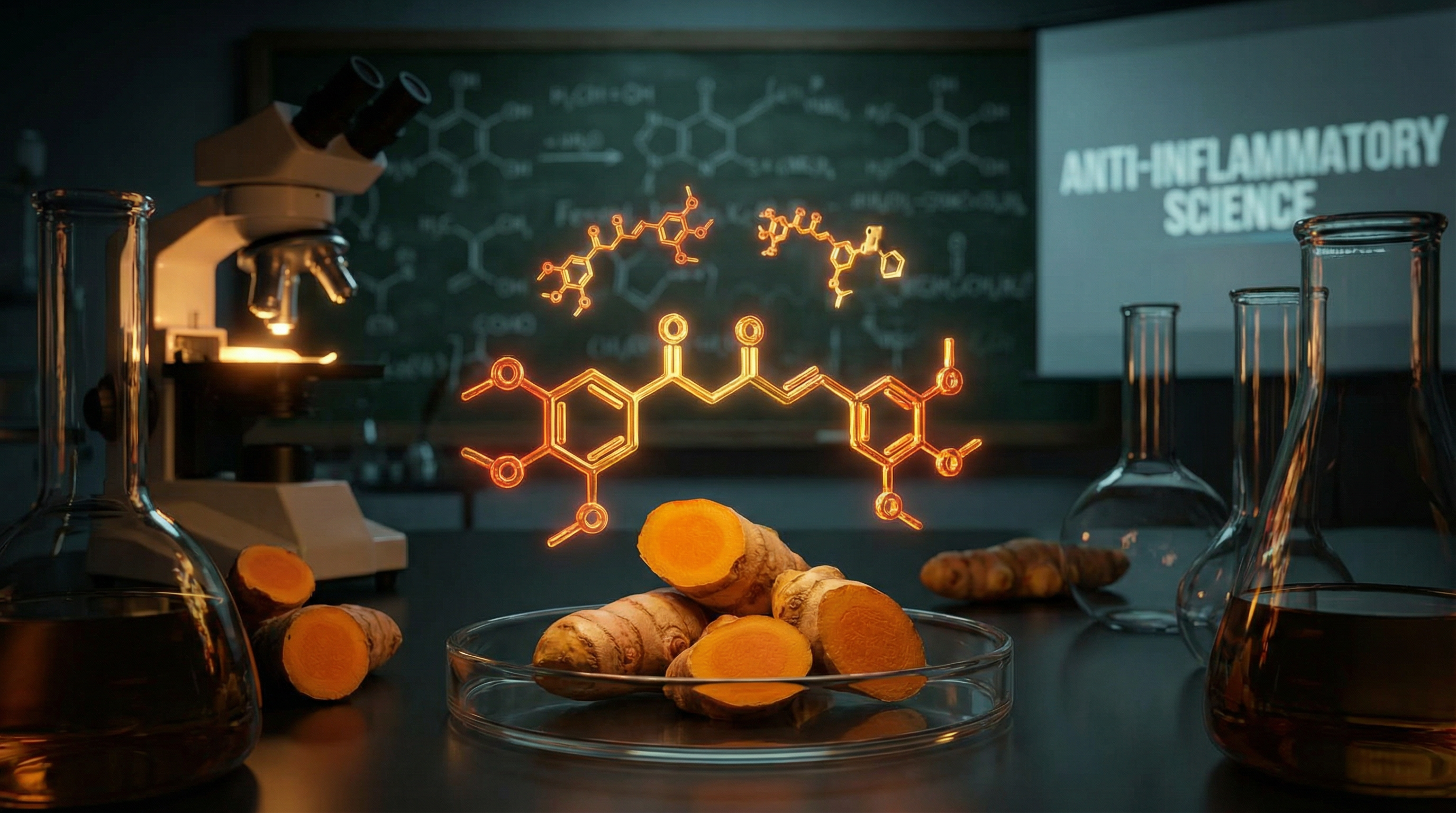
Curcumin, the polyphenolic pigment that gives turmeric its orange color, is one of the most extensively studied natural anti-inflammatories on the planet. With more than 15,000 peer-reviewed publications, it has repeatedly demonstrated the ability to modulate NF-κB, activate AMPK, enhance mitochondrial biogenesis, and even mimic several of the pathways targeted by caloric restriction.
But curcumin is also notoriously tricky. Raw turmeric powder is less than 3% curcuminoids, and plain curcumin has poor oral bioavailability. This guide walks through the science, the dose, and the formulations that actually work.
What Is Curcumin?
Curcumin (diferuloylmethane) is a lipophilic polyphenol extracted from the rhizome of Curcuma longa — the turmeric plant native to South Asia. It belongs to a family of three closely related curcuminoids: curcumin, demethoxycurcumin, and bisdemethoxycurcumin, which collectively make up the bioactive fraction of turmeric.
Traditional Ayurvedic medicine used turmeric for joint pain, digestion, and wound healing long before modern pharmacology caught up. Today, curcumin is recognized as a pleiotropic molecule — meaning it acts on dozens of molecular targets simultaneously, including transcription factors, cytokines, growth factors, and enzymes involved in aging.
How Curcumin Works: Mechanisms Relevant to Longevity
1. Suppression of NF-κB and Inflammaging
NF-κB is the master transcription factor of inflammation. In aging tissues, NF-κB is chronically activated, driving the expression of TNF-α, IL-6, IL-1β, and COX-2. Curcumin directly inhibits IκB kinase, keeping NF-κB in its inactive cytoplasmic state.
Human trials consistently show curcumin reduces high-sensitivity CRP (hs-CRP) by 20-50% over 8-12 weeks — a biomarker strongly tied to cardiovascular and all-cause mortality risk.
2. AMPK Activation and Caloric-Restriction Mimicry
Curcumin activates AMP-activated protein kinase (AMPK), the cellular energy sensor that senses low ATP and responds by upregulating fatty acid oxidation, mitochondrial biogenesis, and autophagy. This overlaps heavily with the mechanisms behind rapamycin and mTOR inhibition and fasting-based interventions.
3. Nrf2 Pathway Activation
Like sulforaphane, curcumin is a potent Nrf2 activator. Nrf2 triggers the endogenous antioxidant response, upregulating glutathione synthesis, heme oxygenase-1, and superoxide dismutase. This matters because dietary antioxidants alone cannot match the power of your own enzymatic antioxidant system.
4. Mitochondrial Biogenesis
Curcumin upregulates PGC-1α, the master regulator of mitochondrial biogenesis. Animal studies show increased mitochondrial density in skeletal muscle and brain tissue, complementing strategies in our mitochondrial supplement stack guide.
5. Senescence and SASP Modulation
Emerging evidence suggests curcumin partially suppresses the senescence-associated secretory phenotype (SASP) — the inflammatory cytokine cocktail released by senescent “zombie cells.” While it is not a true senolytic like fisetin, it may function as a senomorphic — reducing the harm senescent cells inflict without killing them outright.
Key Health Benefits
Joint Health and Osteoarthritis
A 2021 meta-analysis of 11 randomized trials (n=1,009) found curcumin extracts reduced WOMAC pain scores comparably to NSAIDs in knee osteoarthritis, with a far superior safety profile. Doses ranged from 500-1,500 mg/day of standardized extract.
Cardiovascular Protection
Curcumin improves endothelial function, lowers LDL oxidation, and reduces arterial stiffness. A 2019 trial in postmenopausal women found 8 weeks of curcumin (150 mg/day of bioavailable form) improved flow-mediated dilation equivalent to aerobic exercise training.
Cognitive Function and Neuroprotection
The Small et al. 2018 UCLA trial (n=40, 18-month duration) used 90 mg of bioavailable curcumin (Theracurmin) twice daily. Participants showed significant improvements in memory and attention, plus reductions in amyloid and tau accumulation in the amygdala and hypothalamus on PET imaging.
Metabolic Health
Curcumin improves fasting glucose, insulin sensitivity, and HbA1c in prediabetic populations. A landmark 2012 trial found curcumin prevented progression from prediabetes to type 2 diabetes in 100% of the treatment group versus 16.4% progression in placebo over 9 months.
Depression and Mood
Multiple RCTs show curcumin is roughly equivalent to SSRIs for mild-to-moderate depression, likely via BDNF upregulation and inflammation reduction. Typical dose: 500-1,000 mg/day of enhanced-absorption form.
The Bioavailability Problem (And How to Solve It)
Plain curcumin powder has an oral bioavailability of less than 1%. It is rapidly metabolized by the liver into inactive glucuronides and sulfates, and most of what you swallow never reaches systemic circulation. This is why formulation matters more than dose.
Enhanced Absorption Formulations
| Formulation | Bioavailability vs. Plain | Typical Dose |
|---|---|---|
| Plain curcumin (95% extract) | 1x (reference) | 1,000-2,000 mg |
| Curcumin + piperine (BioPerine) | 20x | 500-1,000 mg |
| Phytosome (Meriva) | 29x | 500-1,000 mg |
| Theracurmin (nanoparticle) | 27x | 180-360 mg |
| Longvida (SLCP) | 65x brain penetration | 400-800 mg |
| NovaSol (liquid micelle) | 185x | 150-300 mg |
For general longevity use, a piperine-enhanced or phytosome formulation at 500-1,000 mg/day is a reasonable, cost-effective choice. For cognitive protection, Longvida or Theracurmin have the best brain-penetration data.
Dosage Guide
| Goal | Form | Daily Dose | Notes |
|---|---|---|---|
| General anti-inflammation | Curcumin + piperine | 500 mg | Taken with fatty meal |
| Joint pain / osteoarthritis | Meriva or Theracurmin | 1,000 mg | Split AM/PM |
| Metabolic / cardiovascular | Any enhanced form | 500-1,000 mg | With breakfast |
| Cognitive protection | Longvida or Theracurmin | 400-800 mg | With dietary fat |
| Mood / depression adjunct | Enhanced form | 500-1,000 mg | Consult physician if on SSRIs |
Timing: Curcumin is fat-soluble. Always take with a meal containing at least 5-10 grams of fat for maximal absorption.
Stacking Curcumin With Other Longevity Compounds
Curcumin complements several pillars of a rational longevity stack:
- With resveratrol: Synergistic AMPK and Nrf2 activation; resveratrol hits SIRT1 while curcumin hits NF-κB
- With omega-3s: EPA/DHA suppress inflammatory eicosanoids while curcumin blocks NF-κB transcriptionally — two complementary anti-inflammatory layers
- With NMN or NR: NAD+ boosters rebuild mitochondrial capacity; curcumin reduces the inflammatory drag on those mitochondria
- With quercetin: Both are polyphenols with partially overlapping but non-redundant effects on senescence and inflammation
Avoid stacking curcumin with high-dose fish oil immediately before surgery — both have mild antiplatelet effects.
Safety Profile and Precautions
Curcumin is remarkably safe. Doses up to 12 grams per day have been tested in humans without serious adverse events. Common, mild side effects include GI upset, loose stools, or nausea — usually dose-dependent.
Who should be cautious:
- Gallstones or bile duct obstruction: Curcumin stimulates gallbladder contraction
- Iron deficiency anemia: Curcumin chelates iron at high doses
- Anticoagulant users: Mild antiplatelet activity — avoid high doses with warfarin, DOACs, or dual antiplatelet therapy
- Pregnancy: Food amounts are safe; supplemental doses have insufficient data
- Surgery: Stop curcumin at least 2 weeks before any scheduled procedure
A 2023 safety review raised attention about rare idiosyncratic liver injury with some enhanced-absorption formulations, particularly in individuals with HLA-B*35:01 genetic variant. Baseline liver enzymes before starting high-dose long-term use is reasonable.
FAQ
Can I just eat turmeric instead of supplementing?
Culinary turmeric provides meaningful benefit for general health, but it contains only 2-5% curcuminoids by weight. You would need 5-10 teaspoons daily plus black pepper and fat to reach therapeutic curcumin doses — achievable, but harder than a well-formulated capsule.
Does curcumin work for brain fog and mild cognitive decline?
The UCLA Theracurmin trial showed measurable cognitive and mood benefits over 18 months in adults without dementia. For brain applications, use a Longvida or Theracurmin formulation. Pair it with lion’s mane for complementary BDNF/NGF support.
Is curcumin a true senolytic?
No. Fisetin and quercetin have stronger senolytic data. Curcumin is better classified as a senomorphic — it blunts the inflammatory signaling from senescent cells (the SASP) without necessarily killing them. The two strategies are complementary, not redundant.
How quickly will I notice effects?
CRP and other inflammatory markers typically drop measurably at 4-8 weeks. Subjective benefits like joint comfort often take 2-4 weeks. Cognitive and structural effects require months to years of consistent dosing.
Can I take curcumin long-term, indefinitely?
Evidence from 12-18 month trials shows good tolerability, and population-level turmeric consumption in South Asia spans entire lifetimes without obvious harm. That said, cycling — for example, 5 days on, 2 days off, or 8 weeks on, 1 week off — is a sensible conservative approach for any supplement used chronically.
Bottom Line
Curcumin is one of the most thoroughly validated natural anti-inflammatories available, with direct effects on NF-κB, AMPK, Nrf2, and mitochondrial biogenesis — all pathways central to the biology of aging. It is not glamorous and it will not single-handedly extend your lifespan, but it is one of the highest-confidence, lowest-risk additions to a longevity stack, particularly for those with joint pain, elevated hs-CRP, or a family history of neurodegeneration.
Pick an enhanced-absorption formulation, take it with fat, and give it at least 8 weeks. Then check your inflammatory markers.
For a broader framework on building an evidence-based supplement protocol, see our beginner’s longevity supplement stack guide.